An official website of the United States government. Here's how you know.


 Countdown to





Deep in the heart of South Tyrol, Italy, a team of engineers and contracting specialists recently descended into the marble quarries of Lasa Marmo to inspect a new batch of headstones destined for ABMC cemeteries.
The visit, led by Allison Justiniano, Florian Fortin, and David Simons from the engineering team, alongside Mike Bachofen from contracting, focused on the quality control of 266 marble crosses. These headstones, carved from the pristine white marble of Lasa, will honor fallen American soldiers from World War II.
The Lasa quarry, opened in the 1870s, has a storied legacy. Initially worked by hand, it became a key supplier for the American Battle Monuments Commission in 1949, when the U.S. Embassy in Rome selected the then state-owned Lasa Marmo for a major contract. That same year, the company received its first order for 25,000 headstones. By 1962, Lasa Marmo had produced 90,156 markers — crosses and Stars of David — for 15 U.S. military cemeteries across Europe, North Africa and Asia.
The extraction
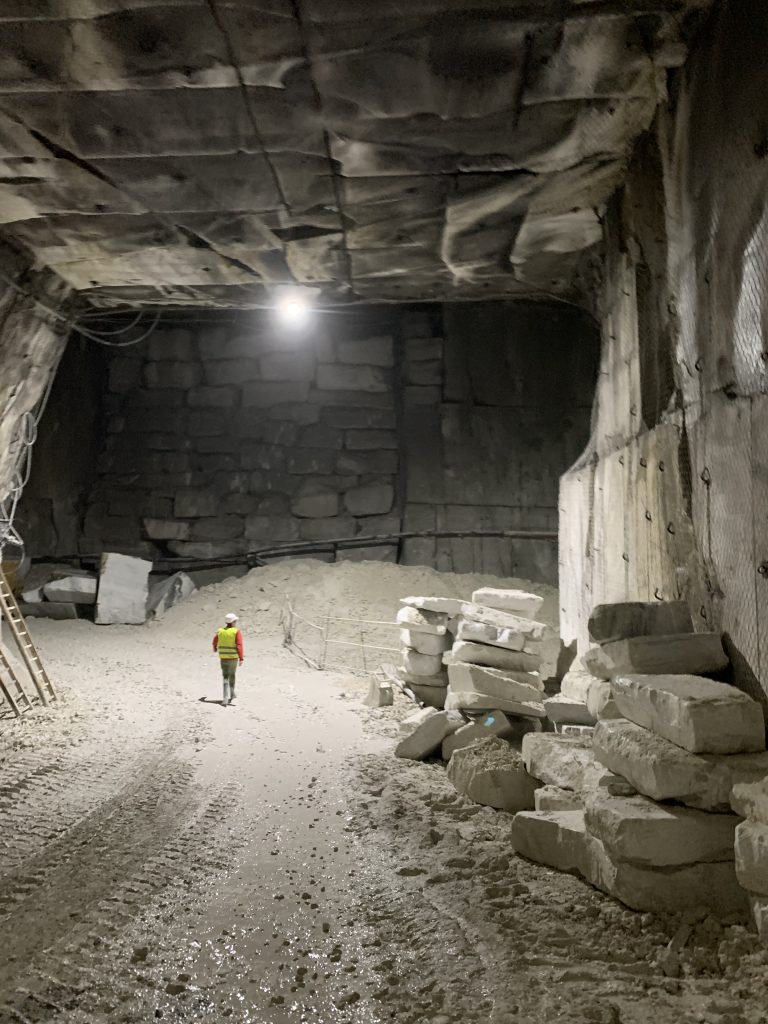
Today, 12 workers operate inside the quarry, while 62 are employed across the company. The mine itself stretches over 4 kilometers of tunnels, with marble deposits reaching 40 meters thick.
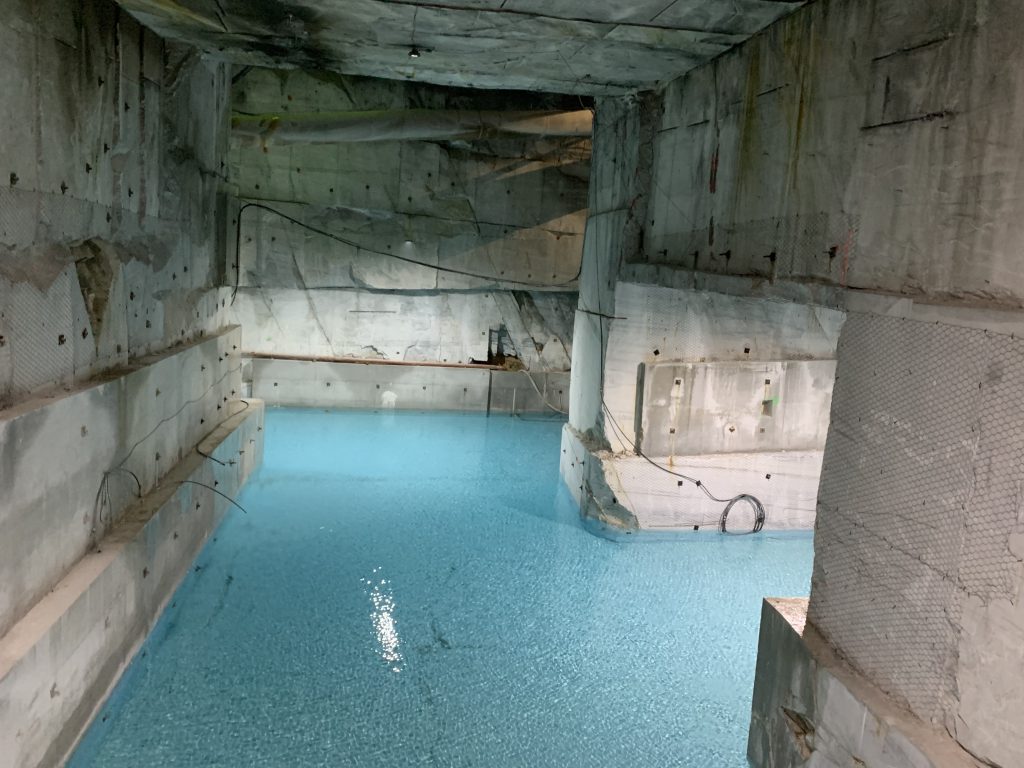
Extraction is a delicate process with columns of marble left intact around the marble blocks being removed to preserve the mountain’s structural integrity. A large yellow pipe circulates fresh air through the galleries, and a permanent pump keeps water levels low in a natural basin formed by infiltration. Excavation in the basin area is only possible from November to May, when snowmelt is minimal and it is possible to pump out the collected water.
Diamond cutting wires are used to cut the blocks of marble out of the mountain, costing roughly 3,000 euros each, last only two to three months before needing to be replaced. The largest machine in the quarry cuts one square meter of marble per hour.
A dedicated space within the quarry is reserved for ABMC operations. As of today, “only 1% of the marble has been extracted since the quarry’s opening,” explained a representative of Lasa Marmo.
Each day, the truck drags marble blocks weighing between 5 and 30 tons—the maximum load the mountain road can handle—down from the mountain.
The production
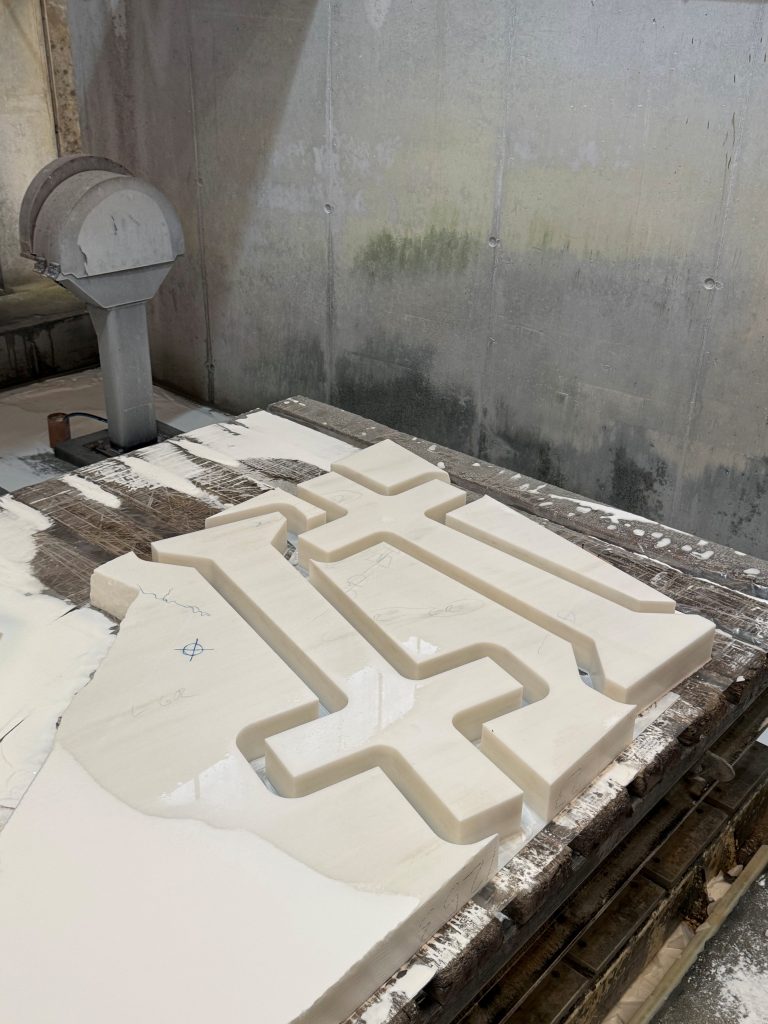
The production of each headstone takes nine hours. Milling the shape requires four hours, followed by two hours to reduce the thickness from 11 to 9 centimetres. One hour is spent honing the front and back by machine, and two more hours are needed to finish the sides and bevels by hand. Each cross weighs approximately 65 kilograms.
The cutting process begins with a hand-drawn outline on a defect-free section of marble. A photo of the sketch is scanned and sent to the cutting machine, which executes the design with precision.
“Previously, the annual order was of approximately 200 headstones. This is set to increase significantly,” explained David Simons, engineering director. “In fiscal year 2026, ABMC plans to order 900 Lasa headstones.”
The increase over the next several years, according to Simons, will allow ABMC to work ahead of replacement needs for headstones that have become damaged, worn, or are otherwise no longer serviceable.
During the inspection, crosses were examined both indoors and outdoors to assess color, veining, bevel dimensions and overall straightness of cuts. “Philippe Lafleur, a robotic operator at Oisne Aisne American Cemetery, joined via video call to confirm technical details” shared Florian Fortin, engineering Deputy Director.
Of the 266 crosses reviewed, five were rejected, 12 required repolishing and three will be reworked in the workshop. Rejections stemmed from visible grey or white veins, that are unaesthetic but could also compromise structural integrity — especially if the names are engraved too close to a dark vein. The other criteria for rejection could be insufficient whiteness, embedded stones, oversized or undersized bevels, and fissures.
“We’re exploring a shift from full-scale quality control to a quality assurance model,” said Allison Justiniano, Chief of engineering. “By sharing our SOP and training the quarry team on our criteria, we could delegate initial inspections to Lasa Marmo and focus only on headstones requiring special attention.”